
From Stockyards to Stand: The Anatomy of Chicago Italian Beef
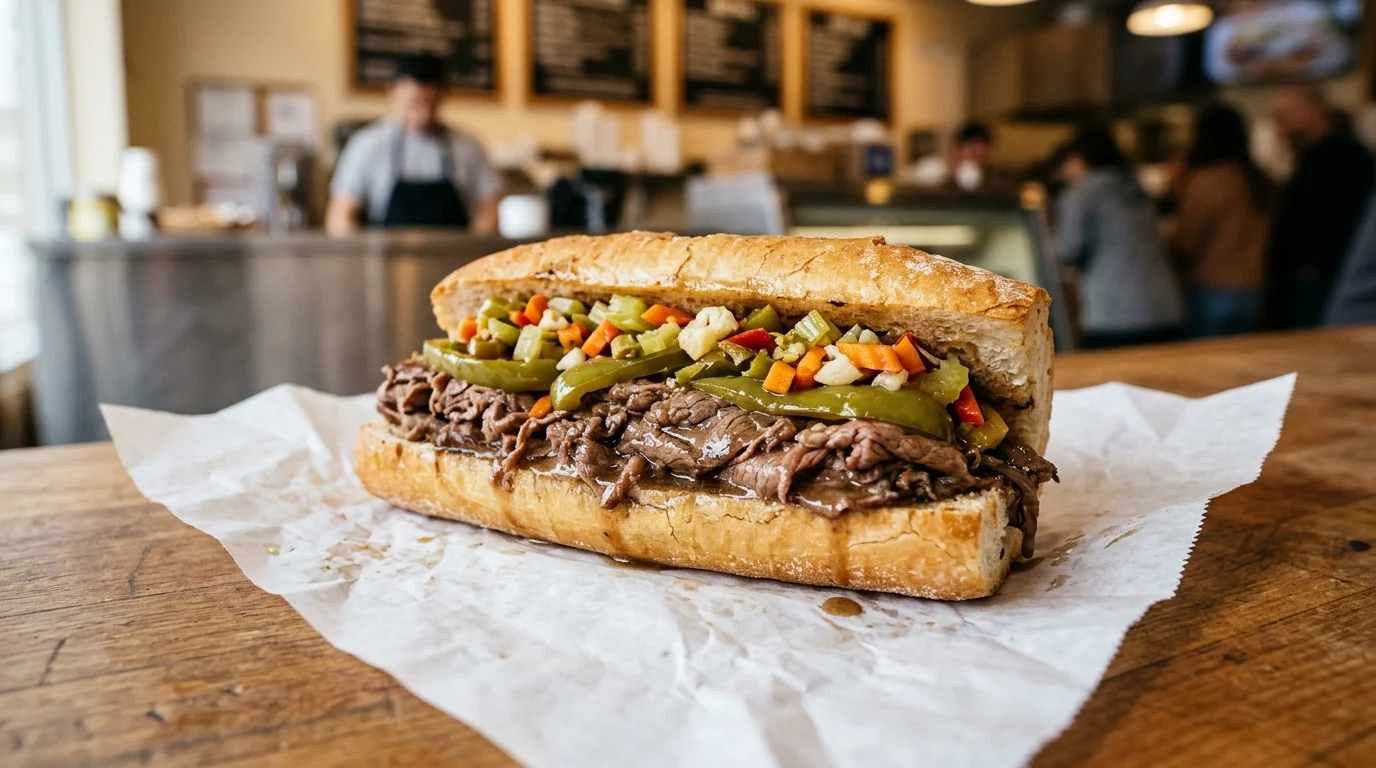
In the global pantheon of regional American sandwiches—alongside the Philadelphia cheesesteak, the New Orleans po'boy, and the Maine lobster roll—none possesses an origin story so intrinsically tied to industrial labor and immigrant resilience as the Chicago Italian beef.
The story begins in the early twentieth century inside the sprawling, blood-soaked labyrinth of the Union Stock Yards. Tens of thousands of Italian immigrants, having fled poverty in Southern Italy, worked grueling shifts processing cattle for the meatpackers of Armour, Swift, and Morris. The prime cuts—tenderloins, ribeyes, and strip loins—were shipped on refrigerated railcars to luxury hotels and steak houses in New York and Boston. What remained for the immigrant working class were the tougher, fibrous cuts: bottom round, eye of round, chuck, and neck.
The Wedding Banquet Solution
When Italian-American families celebrated life milestones—weddings, confirmations, and wakes—hospitality dictated feeding large extended families. Yet meat was costly. To solve this dilemma, home cooks developed a revolutionary roasting and slicing technique.
A whole beef round was heavily coated with an aromatic dry rub of sea salt, crushed garlic, wild dried oregano, coarsely cracked black pepper, and chili flakes. It was placed into a roasting pan filled with water, onion trimmings, and bay leaves, then roasted slowly for hours. As the roast cooked, its juices rendered directly into the spiced water, creating a thin, glossy, intensely aromatic broth (*au jus*).
The true stroke of genius came after cooking. Rather than slicing the hot beef thickly, the meat was cooled overnight in the icebox until firm. The following morning, cooks sliced the cold beef paper-thin against the grain on manual deli slicers. When a piece of meat is sliced to the thickness of tissue paper, its fibrous muscle grain is severed into microscopic ribbons, instantly rendering even the toughest round meltingly tender.
The Bread that Refused to Surrender: Gonnella
Paper-thin beef alone does not make an Italian beef sandwich; it requires a vessel capable of holding simmering broth without dissolving. Enter Chicago's Gonnella Baking Company, founded in 1886. Gonnella formulated a French roll with an extraordinarily tough, blistered exterior crust and a structured, open-cell crumb.
When this roll is plunged into a vat of boiling au jus—a technique known across Chicago as ordering "dipped" or "baptized"—the crumb expands like a sea sponge, trapping ounces of rich spiced liquid within its matrix while the outer crust holds together handheld tension.
Enter Johnnie's: The 1961 Paradigm Shift
By the 1950s, Italian beef had become Chicago's favorite street food, sold at hundreds of corner stands. However, many stands had begun cutting corners—using commercial beef powders, pre-sliced meats, and electric warming trays.
In October 1961, Johnnie Aretos opened Johnnie's Beef on North Avenue in Elmwood Park with a singular, uncompromising vision: elevate the beef sandwich through absolute culinary purism. Whole roasts were prepared fresh every morning. Real garlic was simmered low and slow with bay leaves. Real hardwood charcoal was burned in the pit behind the counter. And to cleanse the palate after the garlic-rich richness of the beef, Johnnie created a proprietary, house-made Italian lemon ice.
Today, six decades later, under the stewardship of Johnnie's son-in-law Frank Stompanato, the recipe has never changed. It remains the gold standard against which every Italian beef on earth is measured.